
Photo by Aerps.com on Unsplash
Introduction
This week, I’m taking a break from my usual weekly walkthrough format to try something different. This is the first edition of my real world diary series, StumbleSOC Stories: A collection of field notes and anecdotes. This particular case is adapted from a short presentation I gave to a team of software developers about a real-world incident back in July 2025 meant as a cautionary tale that bridges blue team operations, DevOps, and the rise of vibe coding with open source software supply chain attacks.
We’ll take an inside-out approach, exploring how a security alert investigation lead to stumbling upon a software supply chain compromise. But what’s the catch? Well, the malware was delivered through AI-generated code created using a Generative AI tool outside of corporate governance policies, creating a perfect opportunity for risk.
This blog is especially relevant for those new to coding who rely on vibe coding — experimenting with GenAI prompt-based coding and trusting the output without fully understanding the implications. The goal here is to illustrate how quickly curiosity can turn into compromise with a brief look from a network defender’s point of view, and some practical tips to prevent something like this from happening to you.
The Alert That Started It All
This story starts as all good stories do — a hot summer’s day and a high-severity incident firing from a newly onboarded user’s device:
Potential hands-on-keyboard pre-ransom activity detected
It’s enough to make the hairs on the back of any defender’s neck stick up, and that’s what kicked off the triage. Three alerts, one incident, and a suspicious file: node-gyp.dll.
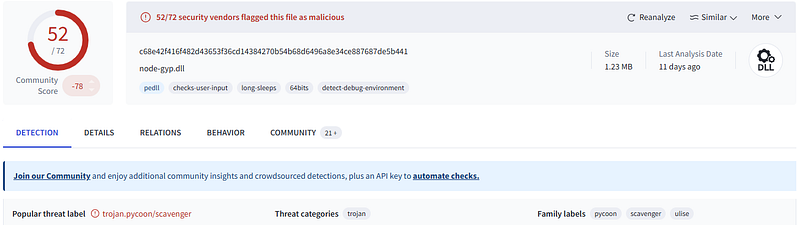
While this file was tagged as malware, at first glance, it looked like a false positive. Nothing overtly suspicious was observed, and VirusTotal showed low detection rates.
But something was strange: this workstation belonged to a new, non-developer user, we’ll call him “Justin,”
and the DLL was linked to the package napi-postinstall — a Node.js package with millions of downloads and favorable metrics.
What was “Justin” doing with Node.js anyway?
The AI Stumble
Further investigation led to an interview with “Justin”, and that’s when it clicked:
“I’m really REALLY ignorant about this stuff. I was messing with it to try and learn more about coding and Ai prompting.“Translation: Vibe coding. This is the currently trending practice of using Generative AI to generate code or prompt an app into existence. This user had used their personal Generative AI chat subscription to generate Node.js code with the goal of learning to code and experiment with AI prompting.
While this is a totally valid use case on its own, you can probably guess where this is going. Once run, the AI-generated code pulled dependencies from the NPM registry. One of those was the napi-postinstall script, which contained instructions to execute the suspicious node-gyp.dll. The user ran the code on their corporate device, and that’s when the alerts fired.
Malware or Misunderstanding?
Okay, so we now understand the how, but why did the endpoint detection tool flag node-gyp.dll as malicious?
Remember, VirusTotal showed minimal detections at the time of the alert. The package looked clean. But the next day, the detection rate skyrocketed as reports started rolling in overnight — there was even a CVE assigned (CVE-2025-54313).
Update — January 2026: This CVE has also been added to CISA’s Known Exploited Vulnerabilities Catalog as of January 22nd, 2026.
From the excellent reporting by Socket.dev, it was revealed that this DLL was part of a broader campaign. A phishing attack had compromised an NPM maintainer’s token, allowing attackers to inject malware into several trusted packages, including the one found on Justin’s workstation: napi-postinstall version 0.3.1.
In other words, textbook software supply chain attack.
Meet the Malware: The Scavenger Family
Understanding that this was a true positive meant getting a better understanding of the malware. According to the VirusTotal family label, this confirmed-malicious DLL, node-gyp.dll, belongs to the Scavenger malware family. According to Malpedia, Scavenger is:
A stealthy, two-stage malware family first observed in July 2025 following a targeted supply chain attack on the NPM ecosystem. The infection began with a phishing campaign that leveraged a typo-squatted domain (npnjs.com) to impersonate the legitimate NPM login page.
So, what we observed was the Scavenger Loader component. In this case, thanks to the endpoint detection response (EDR) tool on the victim’s device, the sensor flagged the behavior of the first-stage loader (node-gyp.dll) triggered via rundll32.exe as suspicious.
Then the antivirus software identified the malicious Scavenger DLL as malware and terminated it during execution, preventing the second-stage infostealer payload from being retrieved. The threat was quarantined, and no data collection or exfiltration occurred.
While this is a great example of behavioral detection working as intended, even when signature-based detection lagged behind, it’s also a great example of how technical controls are essential even when the administrative policy controls (like an Acceptable Use Policy) should have deterred this from happening to begin with.
Yes, the user technically executed the code but is it really their fault or simply bad timing that created another victim downstream?
Understanding the Open Source Software Supply Chain Risk
Let’s pull back a little and look at the bigger picture. Modern applications rely on hundreds of third-party dependencies. Even if you’re confident your code (or your AI-generated code) is safe, your dependencies might not be. And when those dependencies are compromised, the impact can cascade downstream, which is exactly what we saw earlier happen with our victim, “Justin”.
The risk is that supply chain attacks aren’t just about initial access. They’re about the attacker’s objectives and impact. A few examples might include:
- Stealing cloud service keys, SSH credentials, and maintainer tokens.
- Dropping backdoors.
- Lateral movement in enterprise networks.
- Data theft and ransomware.
Not good, but the worst part? A story like this isn’t an isolated incident. A quick search for “Software Supply Chain Attack"shows dozens of results per week across multiple package repositories like NPM or PyPI. Despite this being an example from July 2025, this is still an ongoing, pervasive, and real threat.
So, What Can We Do?
Let’s tie this together and come up with some practical advice — especially for new developers or vibe-coding hobbyists like Justin.
For Vibe Coders:
If you’re new to software development and rely on vibe coding as your entry point, remember this: AI doesn’t guarantee security. It can pull in compromised packages without warning, just like the victim in this story. So how does a novice developer verify the integrity of AI-generated code?
While it’s a tough nut to crack, and I don’t have all the answers, we can start with some basics. There’s an old cybersecurity adage: “You can’t defend what you don’t know exists.” In this example, it’s true.
Start with some Operational Security Fundamentals
- Don’t assume AI-generated code is safe. AI can pull in dependencies without context. There’s a reason these tools call out that they can make mistakes. Always verify.
- Separate your learning environment from your daily driver. If you’re experimenting, use a Virtual Machine or segmented development environment — not your organization’s resources.
- Stay within approved tools and environments. Governance exists for a reason. If your organization has an approved GenAI application, they probably have some guardrails in place.
- Never tamper with your anti-malware or security software. Yes, I’ve seen this happen, but those tools and alerts saved the day in this case and prevented further impact.
Know Your Dependencies
- For Node.js applications, use
npm lsto list dependencies and[npm audit](https://docs.npmjs.com/auditing-package-dependencies-for-security-vulnerabilities)to check for known vulnerabilities. - Investigate suspicious findings by looking up packages on sites like Socket.dev or Snyk.
- In this example, tools like these would have flagged
napi-postinstallas compromised. Only version0.3.1was affected, but that information was available if the victim had known where to look.
Scale Up with Security Tools
While manual checks help, they’re not scalable. Eventually, you’ll want to integrate:
- Software Composition Analysis (SCA) tools like OWASP Dependency-Check
- Static Application Security Testing (SAST) for source code analysis.
- Dynamic Application Security Testing (DAST) for runtime vulnerability detection.
Key Takeaways
- Verify AI-generated code: don’t trust it blindly.
- Separate experimental environments from production systems.
- Use dependency checks (
npm ls,npm audit) and reputation tools. - Adopt SCA and SAST tools as you grow.
- Never disable security tools. They’re your last line of defense.
Final Thoughts
This saga reminded me how quickly a learning experiment can become a security incident. Awareness is important! Understand that there is risk in the trust-based open source ecosystem. Maintainers are not infallible. With that said, there is obvious value in using GenAI to learn about building applications, and harnessing that power can bring tremendous results. AI is powerful, but it’s also not infallible. And when it intersects with open-source ecosystems, the risks multiply.
But we users also bear the burden of validating the output of these tools and the risks. Just like in standard software development lifecycles, it’s important to move security early into the development of new applications and always be thinking about it as much as you think about the final result. Applying security principles like software composition analysis and vulnerability management is important, fundamentally important, even if you’re new. Security is a vibe too.
This is just a small slice of the bigger pie, and I hope it gave you something to chew on. Thanks for your support and for your time together. If you found this post interesting, don’t forget to give it a clap and consider following me for more content like this! Your feedback really is invaluable, and it pumps me up to support your security journey. Remember, Cybersecurity is a team sport and we’re in this together!
I also want to give a quick shout-out to my colleague Giovanni Contino for generously lending his time — and his developer brain — to review this post. His insights and feedback helped ground the content in real-world dev experience.
Until next week — stay curious and be safe out there!
References
- Socket — " # “Active Supply Chain Attack: npm Phishing Campaign Leads to Prettier Tooling Packages Compromise”: https://socket.dev/blog/npm-phishing-campaign-leads-to-prettier-tooling-packages-compromise
- VirusTotal — node-gyp.dll: https://www.virustotal.com/gui/file/c68e42f416f482d43653f36cd14384270b54b68d6496a8e34ce887687de5b441/detection
- National Vulnerability Database (NVD) — CVE-2025€“54313: https://nvd.nist.gov/vuln/detail/CVE-2025-54313
- Malpedia — Scavenger: https://malpedia.caad.fkie.fraunhofer.de/details/win.scavenger
- NPM Audit: https://docs.npmjs.com/auditing-package-dependencies-for-security-vulnerabilities
- Snyk Advisor: https://snyk.io/advisor
- Socket: https://socket.dev/
- OWASP Dependency-Check: https://owasp.org/www-project-dependency-check/